
There is an enormous amount of waiting on a shoot. Lights get rebuilt, a lens goes missing, someone has to drive back for a memory card, and the rest of us sit. I used to scroll. The stylist I work with most often knits, and after roughly two years of watching her produce socks between setups I finally asked her why. Her answer had almost nothing to do with socks.
In Short
- Riley, Corkhill and Morris, 2013: 3,545 knitters surveyed, and knitting frequency tracked with feeling calm and happy
- Geda and colleagues at the Mayo Clinic, 2011: craft activities associated with 30 to 50 per cent lower odds of mild cognitive impairment in 1,321 older adults
- Knitting with other people produced effects the solitary version did not
- Almost all of this is self-reported, with no control group. Useful, but not a treatment
- 1 What the 2013 survey actually measured
- 2 The memory claim, and how far it actually stretches
- 3 Why the repetition seems to be the active ingredient
- 4 The pain claim I am not going to repeat
- 5 The group version is doing something the solo version is not
- 6 How I would start, having now tried it badly
- 7 Frequently Asked Questions
What the 2013 survey actually measured
It measured what knitters said about themselves, at scale. Jill Riley, Betsan Corkhill and Clare Morris put an online questionnaire to knitters worldwide and got 3,545 usable responses, published in the British Journal of Occupational Therapy in 2013. Eighty-one per cent of respondents reported feeling happier during and after knitting. Among those who described themselves as clinically depressed, 54 per cent said knitting made them feel happy or very happy.
The finding the authors drew out was the dose relationship: the more often someone knitted, the calmer and happier they reported feeling. That pattern is more interesting than a flat “knitters are happy”, because it hints at something the activity does rather than something about the kind of person who takes it up.
It is still a survey. Nobody was randomised, nobody was compared against a group who did something else, and people who dislike knitting do not fill in questionnaires about knitting. I would rather say that plainly than dress a self-report up as a clinical result.
The memory claim, and how far it actually stretches
It stretches to an association in older adults, and no further. In 2011, Yonas Geda and colleagues at the Mayo Clinic published work in the Journal of Neuropsychiatry and Clinical Neurosciences covering 1,321 people aged 70 to 89, 197 of whom already had mild cognitive impairment. Those who engaged in craft activities such as knitting, along with reading and playing games, had roughly 30 to 50 per cent lower odds of that diagnosis.
Lower odds in a snapshot of a population is not the same as protection. People in the early stages of cognitive decline often drop demanding hobbies before they are diagnosed, which would produce exactly this pattern with the causality running backwards. The researchers were careful about that. The lifestyle articles quoting them usually are not.
Why the repetition seems to be the active ingredient
Because it occupies just enough of you. Knitting a plain row demands counting, tension and hand-eye coordination, but not enough thought to hold a worry at the same time. That is the everyday version of what psychologists call a flow state, and it is the same reason people say they think clearly while chopping vegetables or swimming lengths.
My stylist put it less grandly. She said that if her hands are busy she cannot check her phone, and if she cannot check her phone she stops rehearsing the argument she had that morning. That is not a mechanism you can measure, and it matches what the survey respondents described.
The pain claim I am not going to repeat
Knitting is used as a distraction technique, and that is genuinely different from pain relief. Betsan Corkhill, a physiotherapist who has spent years documenting therapeutic knitting, reports that people living with chronic pain say their symptoms recede while they knit. Attention is finite, and an absorbing task competes with pain for it.
What I will not tell you is that a study proved knitting lowers pain levels over three years, or that it raises serotonin. Those lines circulate widely and I could not trace either to a controlled trial. Distraction is real and worth having. It is not a substitute for treating the cause of the pain.
| What gets claimed | What the evidence supports |
|---|---|
| Knitting reduces stress and lifts mood | Consistently reported by knitters themselves, with a dose relationship. No randomised evidence |
| Knitting protects against dementia | Craft activity is associated with lower odds of mild cognitive impairment in one large observational study. Association only |
| Knitting relieves chronic pain | Self-reported relief while knitting, best understood as distraction. Not a pain treatment |
| Knitting rebuilds hand strength after injury | Used in occupational therapy for fine motor work, always alongside a therapist’s assessment, never instead of it |
The group version is doing something the solo version is not
It is doing the social half. The 2013 survey found that knitting in a group had a significant effect on perceived happiness and on contact and communication with other people, over and above knitting alone. Knit-and-natter groups run in libraries, cafés and hospital waiting rooms across the country for that reason as much as any craft one.
There is a practical reason it works better than most organised socialising. Nobody has to perform. You can sit for twenty minutes without speaking and it reads as concentration rather than awkwardness, which makes it unusually easy for people who find a room of strangers difficult.
How I would start, having now tried it badly
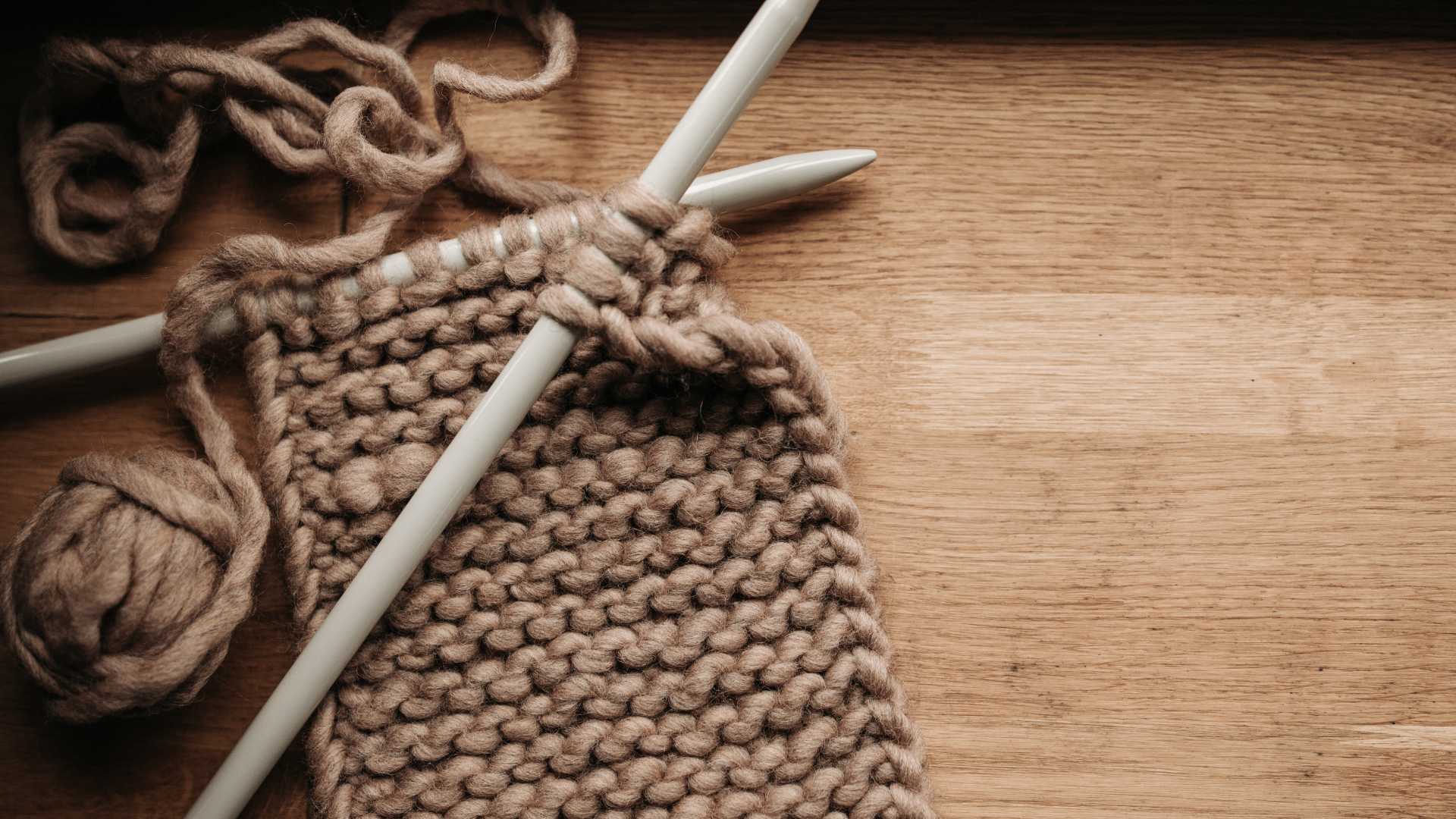
Start with something rectangular and forgiving. I began with a scarf in chunky wool on 8mm needles because thick yarn shows progress fast, and progress is the thing that keeps you going in week one. My first attempt was a hat, which involved decreasing, which involved a tutorial, which involved my phone, which defeated the entire point.
- Buy one ball of chunky yarn and one pair of thick needles. Do not buy a project kit yet.
- Learn casting on and the knit stitch only. That is enough for garter stitch, which is enough for a scarf.
- Give it fifteen minutes in a fixed slot, ideally one currently occupied by scrolling.
- Once the movement is automatic, join something. The group effect in the survey was not small.
The honest version of the payoff, after a few months of doing it in the gaps on set: I am not calmer as a person. I am calmer during those fifteen minutes, and I get a scarf. On a job that runs to eleven at night, that turns out to be worth quite a lot.
Frequently Asked Questions
Is knitting as good for stress as meditation?
Nobody has run the head-to-head trial that would answer that. Knitters describe a state that sounds similar to what meditators describe, and the 2013 survey found calmness tracked with how often people knitted. Treat it as a pleasant, absorbing habit rather than a swap for a practice with its own evidence base.
Will knitting help if I have arthritis in my hands?
It might, and it might make things worse, which is why this is a question for a GP or an occupational therapist rather than a blog. Fine motor activity is used therapeutically, but the right grip, needle weight and session length depend on which joints are affected and how.
Does crochet count, or does it have to be knitting?
The Mayo Clinic work looked at craft activities as a category rather than knitting specifically, so crochet, sewing and woodwork all sat inside it. If the mechanism is absorbed, repetitive handwork, the specific craft matters far less than whether you actually do it.
How long before I notice anything?
The absorbed feeling arrives once the stitch is automatic, which for most people is a few hours of practice spread over a week or two. Before that it is concentration, not calm, and plenty of people give up in exactly that window.
This is general information and not medical advice. Knitting is not a treatment for depression, anxiety or chronic pain. If any of those are part of your life, please speak to your GP about options that are.
Sources: Riley J, Corkhill B, Morris C, The benefits of knitting for personal and social wellbeing in adulthood, British Journal of Occupational Therapy 76(2), 2013; Geda YE et al., Mayo Clinic, Journal of Neuropsychiatry and Clinical Neurosciences, 2011; published accounts of Betsan Corkhill’s work on therapeutic knitting.
What do you do with your hands instead of scrolling?
I am collecting answers, and I suspect half of you have a better one than mine. Tell me in the comments what you picked up and whether you stuck with it.