
Beach jewellery is one of the few style categories that barely moves. I pulled up the list of pieces we were all wearing when this post first went live, and most of it is still in the kit bag I take to summer shoots. What has changed is what I now check before anything touches somebody’s skin.
In Short
- Beaded bracelets, chunky bangles and one oversized ring have outlasted every other beach trend on this list
- The statement necklace has quietly turned into the charm necklace, which is easier to wear and cheaper to build
- UK and EU law caps nickel release from jewellery at 0.5 micrograms per square centimetre per week, and at 0.2 for piercing posts
- Metallic transfer tattoos are harmless; the “black henna” sold next to them on the same beach is not
The original list, eleven summers later
Everything below was in the first version of this article. I have kept the pieces that earned their place and been honest about the two that did not.
Brazilian and Colombian beaded bracelets
Still the easiest win on this list. Hipanema and Mishky are both still going, still handmade, still built on the same principle: sewn beads, mixed colour, a tassel or a magnetic clasp that sits loose on the wrist. They photograph beautifully because the beadwork catches light from several angles at once instead of flashing back at the lens the way polished metal does.
The reason they survived when other 2015 trends did not is that they are soft. Nothing scratches, nothing digs in when you lie on a towel, and a wet bracelet dries out without marking your arm.
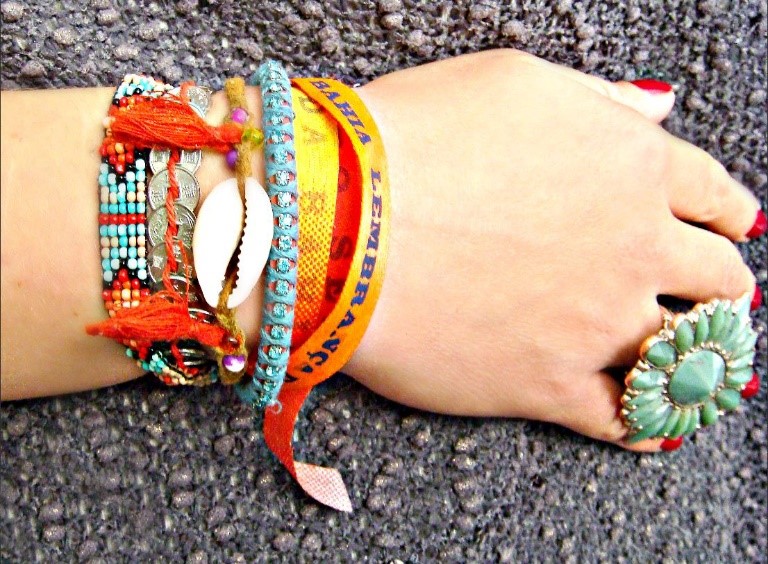
Hipanema bracelet
The tribal ear cuff
The feathered ear cuff was a moment, and the moment passed. What stayed is the plain version: a slim metal cuff worn on one ear with the other left bare, usually paired with a small stud. It still looks good with hair pushed back off a sunburnt face, which is most of what anyone needs from a summer earring.
If you are buying one, the fit matters more than the design. A cuff that grips too tightly leaves a red line within an hour, and a loose one ends up in the sand.
Chunky bangles
Gold, silver, rose gold, engraved or completely plain, worn alone or eight at a time. This is the piece that has moved the least in a decade, and the one I would spend real money on rather than replacing every June. A single heavy bangle against a tan does more than a whole armful of thin ones, though the armful is more fun.
The beaded cuff is the same idea with more texture, and it sits somewhere between the bangle and the Brazilian bracelet.
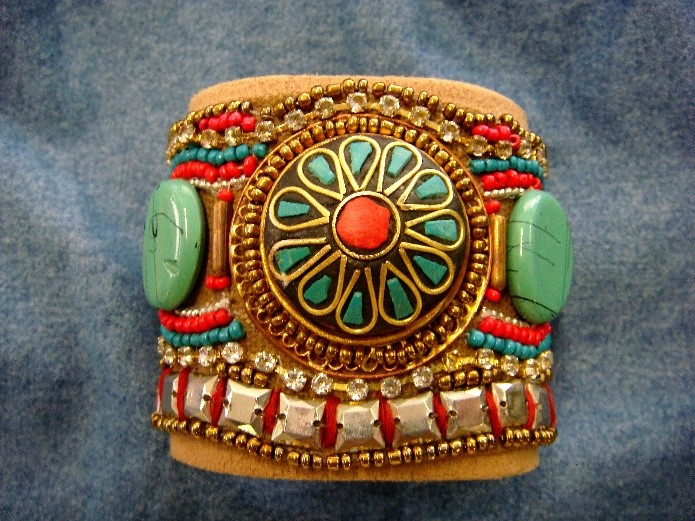
Ethnic Cuff
Skin jewellery and metallic transfers
Flash Tattoos, the brand that made metallic transfers a festival staple, is still trading and still putting out collections. The product itself is straightforward: metallic foil on a transfer sheet, applied with water, gone in a few days. Nothing about it worries me.
What does worry me is the stall next to it. More on that below, because it deserves its own section rather than a line in a shopping list.
The statement necklace, now a charm necklace
The enormous bibbed statement necklace has genuinely dated. What replaced it on the spring/summer 2026 street is the charm necklace: a plain chain that you load up yourself, one charm at a time. Same instinct, far less commitment, and it works over a swimsuit in a way the old feathered version never did.
It also solves the buying problem. A charm chain grows piece by piece, so you are not gambling forty pounds on a single item you might wear twice.
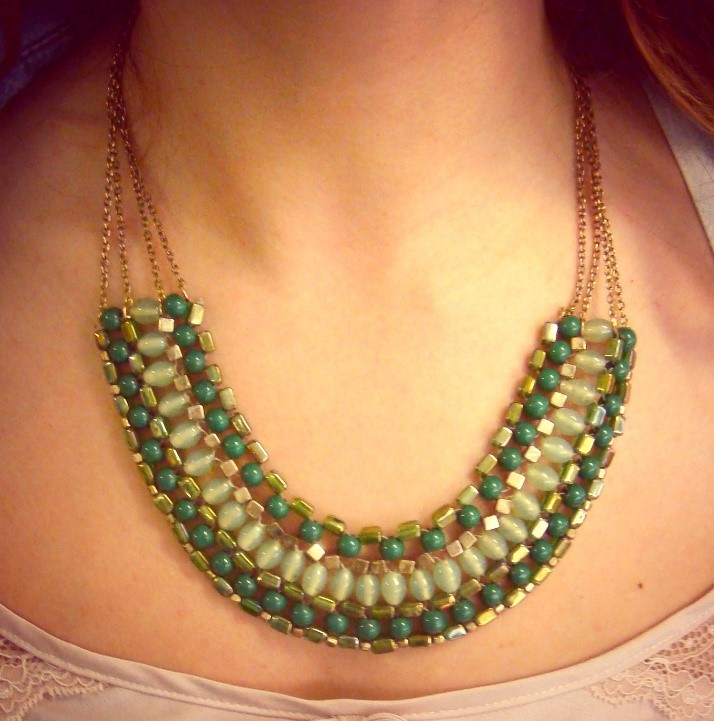
Green statement necklace
The XXL ring
Still worth it, still best on its own. One oversized stone or a wide handmade band on an otherwise bare hand reads as deliberate; the same ring competing with four delicate stacking rings and a knuckle ring reads as clutter. Above-the-knuckle rings have faded a lot since 2015, and I do not miss them.
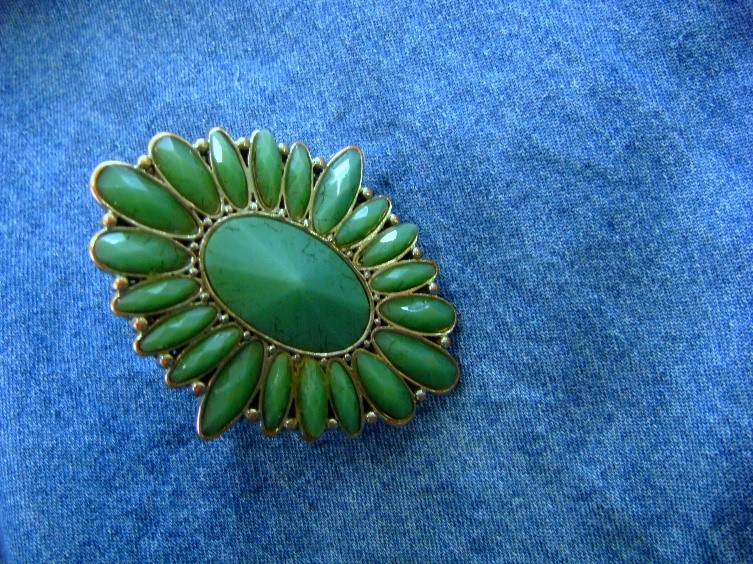
XXL Jade ring
The nickel rule, which is the only shopping advice that really matters
The original version of this article ended with one line about nickel causing allergies. That line was right, and it deserved more than a footnote.
In the UK and the EU, jewellery meant for prolonged skin contact must release less than 0.5 micrograms of nickel per square centimetre per week, and posts that go through a piercing must stay under 0.2. The limits sit in entry 27 of Annex XVII of REACH, and compliance is measured with a standard test, EN 1811, which soaks the item in artificial sweat for a week. Figures quoted by the Nickel Institute put nickel allergy at somewhere between 8% and 19% of European adults, more commonly in women, which makes it one of the most frequent causes of contact dermatitis from jewellery.
The practical translation: the limits apply to jewellery sold legally in this country, and holiday markets are exactly where that assurance gets thin.
| What it says on the label | What is underneath | How it behaves on a beach |
|---|---|---|
| Solid gold, 9ct and up | Gold alloyed with other metals throughout | Nothing to wear off; safest bet for anything you keep on in the sea |
| Sterling silver, 925 | 92.5% silver, usually with copper | Tarnishes faster in salt and sun cream, cleans up easily |
| Gold vermeil | Thick gold plating over sterling silver | Good for a season or two, but the plating thins where it rubs |
| Gold plated or gold tone | Thin plating over an unnamed base metal | Wears through quickly; the base metal underneath is the unknown |
| No metal named at all | Anything | Fine for an evening, not for a week of sweat and swimming |
What salt water, chlorine and factor 50 actually do
Salt and chlorine attack plating, and sun cream is worse than either because it sits in the joins and never fully rinses out. Anything plated will lose its colour at the contact points first: the underside of a bangle, the back of a ring, the clasp of a chain.
Four things I do with jewellery on a beach shoot, and at home:
- Sun cream first, jewellery second, with a couple of minutes in between so it is not sitting in wet lotion.
- Take the plated pieces off before the sea. Solid gold can stay on; vermeil should not.
- Rinse in fresh water and dry properly at the end of the day, especially beaded bracelets with thread or leather in them.
- Keep silver in a closed bag rather than loose in a beach tote, where sand acts like a very slow polish.
The warning that belongs in every beach jewellery article
Metallic transfers are one thing. The “black henna” tattoos sold on the same promenades are another, and this is the part I would want a friend to read before a holiday.
Most black henna is not henna. It contains para-phenylenediamine, a hair dye chemical that is not permitted in products applied to the skin in the EU. A British Association of Dermatologists survey of 244 dermatologists found that it can cause blistering, painful chemical burns and permanent scarring, and that it can leave a lifelong sensitivity to PPD which then makes ordinary hair dye a problem. Around half of the cases reported came from tattoos done within the EU rather than abroad, so this is not only a faraway-market issue.
Real henna stains a reddish brown and takes hours to develop. Anything jet black, painted on in twenty minutes, is not it.
Two questions I get asked on set
My skin goes green under a bracelet. Is that an allergy?
Usually not. Green marking is generally copper in the alloy reacting with sweat and cosmetics, and it washes off. A genuine nickel reaction looks and feels different: itchy, red, sometimes blistered, and it stays put after the piece comes off. If that is what you are seeing, stop wearing the item and speak to a pharmacist or GP rather than trying to work it out from a shopping site.
Can I wear gold and silver together at the beach?
Yes, and it looks better outdoors than it does indoors, because strong daylight flattens the difference between the two metals. The trick is to make one of them clearly dominant instead of splitting the stack down the middle.
If you want to take this further than a beach bag, the piece on matching jewellery to what you are actually wearing goes into necklines, focal points and mixing metals in a lot more detail.
First published April 2015. Rewritten and updated on 14 August 2026. Nothing here is medical advice; a persistent skin reaction is worth showing to a pharmacist or GP.
Sources: REACH Annex XVII, entry 27, nickel restriction, and test standard EN 1811; Nickel Institute, nickel and allergic contact dermatitis; British Association of Dermatologists survey of 244 dermatologists on black henna temporary tattoos, relayed by the British Skin Foundation.
What is the one piece you never take off in summer?
Mine is a single plain bangle that has been through about six holidays and looks better for it. Tell us yours in the comments.
Read next: the wider summer 2026 trends these pieces have to live with