
I started carrying a bag on my Sunday run because of a single stretch of pavement near Sefton Park that never seemed to get cleared. Six months in, I know exactly which junction collects the most cigarette ends, and I have opinions about litter pickers I never expected to have.
In Short
- Plogging began in Stockholm in 2016 with Erik Ahlstrom, and the name blends the Swedish plocka upp with jogging
- A 2022 study in WORK found energy expenditure comparable to jogging, with a higher share of calories coming from fat
- Squat or lunge, never stoop: the same study scored bending at the waist as the highest ergonomic risk of the four postures tested
- Gloves, a picker, daylight and bright clothing are the non-negotiables, and sharps are never your job
Where plogging actually came from
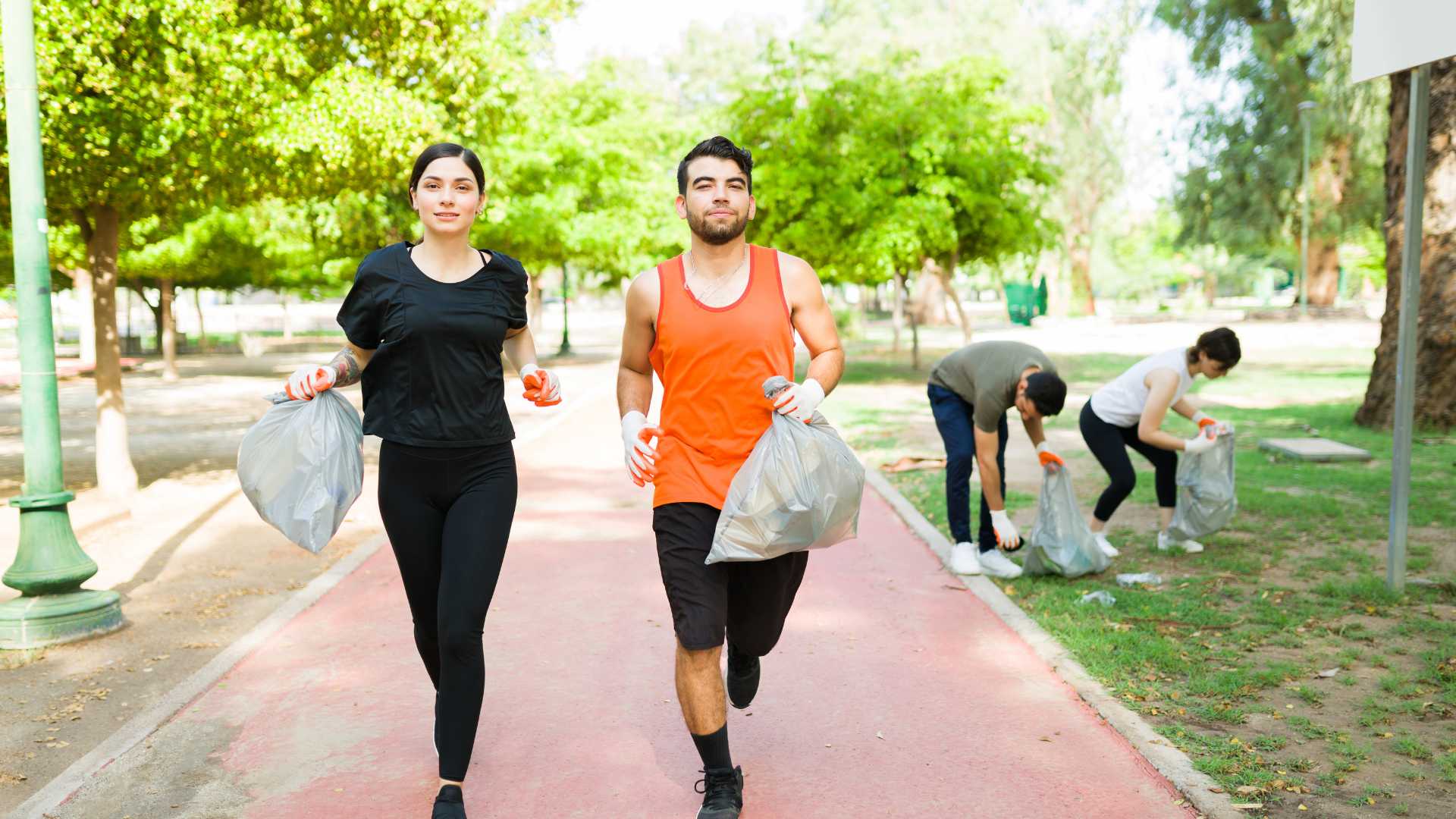
Plogging started in Stockholm around 2016, when Erik Ahlstrom began running with a bin bag after getting fed up with the rubbish he passed on his commute. He had spent three decades organising trail and ski races in Sweden, so he knew how to turn a habit into an event. The word came from his co-founder Karina Svensson, who stitched the Swedish plocka upp, meaning to pick up, onto the English jogging. The organisation they built, Plogga, now counts communities in more than fifty countries.
It tipped from Swedish curiosity to global habit in 2018, the year plastic pollution went properly mainstream in the press. That timing matters: plogging is a small, visible, repeatable action in a subject where most of us feel useless.
The calorie claim everyone repeats, and what the research says
The number quoted everywhere is 288 calories for half an hour of plogging against 235 for plain jogging. It comes from the fitness app Lifesum, which added plogging as a trackable activity in 2018, and it is app-estimated user data rather than a measured trial. It has been copied from article to article ever since.
The one proper study I could find says something more interesting. Raghavan and colleagues, in the journal WORK in 2022, put 36 participants through litter collection in four postures with heart rate monitors on. Energy expenditure for plogging and jogging came out statistically similar, but the proportion of calories drawn from fat was significantly higher when plogging. They also recorded cardiovascular strain at around 99 per cent, which is the part the cheerful trend pieces skip. Stopping, squatting and restarting is harder on the heart than it looks.
The calorie sell is oversold, then, and the real benefit sits elsewhere: a mixed-intensity session instead of a steady one, and forty minutes outdoors with a purpose.
How you bend matters more than how fast you run
Posture is where plogging goes wrong, and the same 2022 study measured it precisely. Using the Rapid Entire Body Assessment scale, where a higher score means a higher risk of musculoskeletal injury, the researchers scored four ways of reaching the ground.
| Posture | REBA score (mean) | What it means in practice |
|---|---|---|
| Stoop (bending at the waist) | 10.31 | Highest risk, and the one most of us default to |
| Semi-squat | 8.11 | Better, still loads the lower back on repetition |
| Lunge | 6.64 | Fine for a single item, keeps the spine upright |
| Full squat | 5.13 | Lowest risk, best when there is a cluster to collect |
Reading that table changed how I plog more than any trend article did. I lunge for a single can, squat properly when there is a pile, and swap the bag between hands so one shoulder is not doing all the work. A long-handled picker removes most of the problem, which is why councils lend them out.
What goes in the bag before I leave the flat
Keep Britain Tidy publishes proper safety guidance for clean-ups, and it is worth following even for a solo half-hour. The minimum kit is a litter picker, a bag and strong gloves, and many local authorities will lend the first two if you ask.
- Bright clothing or a hi-vis, and daylight only. You will be stopping unpredictably near kerbs.
- Gloves you can wash, plus a rigid container for broken glass and disposable barbecues, which should never go loose in a bag.
- Nothing clinical. Needles and syringes are a job for your council, not for you. Note the spot and report it.
- Hands away from your face for the whole session, then wash hands and forearms before you eat or drink anything.
That last rule is the one I am militant about, and it comes from the day job. I spend my working life telling models not to touch their faces, and the reflex to push a stray hair back happens without thinking. Do it wearing a glove that has just held a takeaway box and you will regret it. Anyone tempted to pair this with the barefoot habit should read the urban ground hazards in my piece on walking barefoot in an urban environment first.

The litter you find says a lot about your street
Once you start looking, litter stops being a vague mass and turns into categories. Keep Britain Tidy reports that cigarette butts account for around 66 per cent of littered items here, even though only about one in ten adults now smokes regularly. A butt is not biodegradable: it breaks into microplastics and carries thousands of chemicals. Clearing all of it costs local authorities around a billion pounds a year, and the same charity found that more than 26.8 million UK adults, close to half, admit to littering themselves.
There is good news buried in those figures. Keep Britain Tidy’s National Survey of Cigarette Litter recorded a 17 per cent drop between 2022 and 2024, so targeted campaigns do move the needle. Across the Atlantic, Keep America Beautiful runs the Great American Cleanup on the same logic, and its affiliates removed more than 8.1 million pounds of litter and debris in 2025 alone.
Doing it with other people
Plogging alone is fine. Plogging with three friends is better, and not for motivational reasons: a group covers a whole park rather than one path, and the collective pile at the end is a sobering visual.
The easiest UK entry point is the Great British Spring Clean, which runs from 13 to 29 March 2026 and draws over 400,000 volunteers most years. Equipment is usually provided and the routes are already scoped. Running clubs and schools organise their own sessions the rest of the year, and starting one takes a group chat and a box of gloves.
Questions I get asked about plogging
Do I need to be a runner to try it?
No. Picking litter up while walking, sometimes called plalking, collects the same rubbish and suits anyone whose knees would rather not add squats to a run. The environmental result is identical.
Does the extra weight make it a better workout?
A filling bag adds asymmetric load, which is why swapping hands matters, but the 2022 WORK study found total energy expenditure comparable to ordinary jogging. Treat the bag as a reason to slow down, not as a training tool.
What do I do with what I collect?
Sort what is genuinely recyclable at home and bin the rest. Most of it will be contaminated food packaging that cannot be recycled, and putting it in the recycling anyway causes problems further down the line.
I am not going to pretend a Sunday bin bag fixes plastic pollution. What changed for me is smaller and more selfish: I run slower, I notice my own neighbourhood, and I come back having tidied something. If your usual route has a stretch that bothers you every single time, start there.
Updated 11 August 2026. General wellbeing information, not medical advice. If you have a back, knee or heart condition, check with your GP before adding repeated squatting to your running.
Sources: Plogga on the origins of plogging, Stockholm, 2016; Raghavan R, Panicker VV, Emmatty FJ, Ergonomic risk and physiological assessment of plogging activity, WORK, vol. 72, 2022; Lifesum in-app activity estimates, 2018; Keep Britain Tidy littering and smoking-related litter data; Keep America Beautiful, Great American Cleanup 2025.
Tell me what your route looks like
If you try one plog this month, come back and tell me what you found and how far you got. I am collecting the worst junctions in the comments.
Read next: why travelling less but better beats cramming it all in